Weekly Structure for Shared Reading in Kindergarten
Shared reading is a strategy that can support the didactics of the Big 6 elements of reading: oral linguistic communication and early experiences with print, phonological awareness, phonics, vocabulary, fluency and comprehension. (Konza, 2016).
Solar day one can focus on reading for meaning and enjoyment. Day ii to five could focus on a rereading with explicit teaching based on the to a higher place elements.
Using fluency and expression to read a text with repetitive segments
Lesson overview
This lesson will require students to heed to and join in with the reading of an enlarged, shared text that contains rhyme and repetition.
Text details
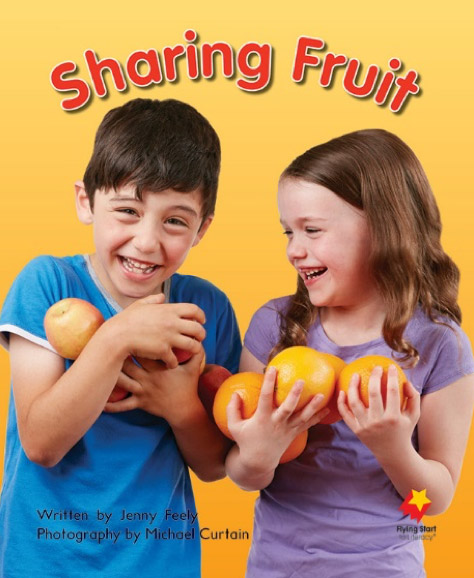 Sharing Fruit, Author Jenny Feely.
Reproduced by permission. Source: Sharing Fruit, Author Jenny Feely, Programme Flying Start to Literacy published past Eleanor Curtain Publishing Pty Ltd. © EC Licensing Pty Ltd.
Text contains
The text contains opportunities for the teacher to:
- model fluent and expressive reading
- encourage students to place and generate rhyming words
- blend and segment single syllable words.
The text contains opportunities for the student to:
- hear what fluent and expressive reading sounds like
- track text as it is being read to reinforce early reading behaviours
- join in with the teacher on the repetitive sections of the text
- place and generate examples of onset and rime (eg: vine, mine)
- run into the instructor model strategies to ensure reading for meaning.
The text contains:
- rhyme (tree/me, dejeuner/munch)
- rhythm (Two red apples on the tree. Ane for yous and ane for me.)
- repeated segments (munch, munch, munch)
- digraph /ch/ in munch, lunch, bunch, crunchy, each, cherries
- blend 'cr' in crispy, crunchy
- punctuation marks: full stop, majuscule letter, comma, question marker, exclamation mark, quotation marks.
Links to the Victorian Curriculum - English
Foundation - Reading and viewing
Read texts with familiar structures and features, practising phrasing and fluency, and monitor meaning using concepts most print and emerging phonic, semantic, contextual and grammatical knowledge. For more information, come across: Content clarification VCELY152.
Level one - Reading and viewing
Read texts with familiar features and structures using developing phrasing, fluency, phonic, semantic, contextual, and grammatical knowledge and emerging text processing strategies, including prediction, monitoring pregnant and rereading. For more data, run into: Content description VCELY187.
Level ii - Reading and viewing
Read familiar and some unfamiliar texts with phrasing and fluency by combining phonic, semantic, contextual and grammatical knowledge using text processing strategies, including monitoring significant, predicting, rereading and cocky correcting. For more information, see: Content clarification VCELY221.
Links to Victorian Curriculum - English language equally an Boosted Language (EAL)
Pathway A
Reading and viewing
Level A1
- Read short, familiar texts (VCEALC030)
- Adopt the teacher's intonation patterns when reading familiar texts (VCEALL054)
- Participate in shared reading activities (VCEALA037)
- Place repetitive words or phrases in known texts (VCEALL047)
- Adopt the instructor'south intonation patterns when reading familiar texts (VCEALL054)
Level A2
- Sympathize information in texts read and viewed in form (VCEALC113)
- Employ cognition of context, text structure and language to sympathise literal and inferred meanings (VCEALC114)
- Read familiar texts with some fluency (VCEALL135)
- Participate in elementary group activities based on shared texts (VCEALA119)
- Read familiar phrases and sentences with fluency (VCEALL128)
- Read familiar texts with some fluency (VCEALL135)
Learning intention
We are learning to read with phrasing and fluency.
Success criteria
I can use the rhythm of the text and placement of words on the page to help me read with phrasing and fluency.
Role of the reader
Text decoder/ Text participant/ Text user
Lesson sequence
- Introduce the learning intention and success criteria for the lesson.
- Today we are learning about how to read with phrasing and fluency. When we read fluently and group words together in phrases, it can help us understand what we read. It is of import to empathize what we are reading.
- I am going to evidence you how to grouping your words together in phrased units and use the rhythm of the text to aid me read this text. Y'all will have a chance to practise this skill reading some of the pages in this book; to yourself and with a partner. You will know you are successfully reading with phrasing and fluency when you receive feedback from each other and me at the lesson determination.
- Ensure text is displayed in front of students then they can see the enlarged font and photographs. Introduce text. "This text is about two children who share some fruit. While I read, see if yous can proper noun and remember all the different types of fruit they share and consume".
- Begin reading. Use a pointer to track the words and so students tin see early reading behaviours such every bit left to right, render sweep, tiptop to bottom, discussion by word matching.
- Equally the text is read, model phrasing and fluency, using the natural rhythm of the text to assist.
- Subsequently reading, check for understanding.
- Ask students who was in the text, what and how much fruit was eaten (literal comprehension).
- Ask students why the boy ate all the other fruit except for the lemon? (inferential comprehension).
- Reread the text. Inquire students to listen out for the style the text sounds. Encourage students to join in with the repetitive segments. Discuss.
- Return to folio 2. Model reading page two and enquire students to clap the design as the teacher reads. What practise they notice? Inquire them to join in and reread page 2 over again. Bespeak out that the text has been written to back up phrasing and fluency. Each line is a new phrase.
- Repeat process with folio 3.
- Make copies of the written text from page 2 and 3. Ask students to read with a partner, using the rhythm to assist their phrasing and fluency. Partners give feedback on whether the reading sounds phrased and fluent. The teacher roams the paired groups modelling and giving feedback equally required. Select students to share their reading.
- Students render to the principal group. Selected students share their reading with the whole group. Listen for rhythm, phrasing and fluency.
- Revisit success criteria. Cheque which students experience confident reading with phrasing and fluency and which students require more practise. Comment student records.
Identifying and generating rhyming words
Lesson overview
This lesson will require students to listen to and bring together in with the reading of an enlarged, shared text that contains rhyme and repetition.
Text details
Sharing Fruit, Author Jenny Feely.
Reproduced by permission. Source: Sharing Fruit, Author Jenny Feely, Programme Flying Get-go to Literacy published past Eleanor Curtain Publishing Pty Ltd. © EC Licensing Pty Ltd
Text contains
Enlarged text (large book), unlevelled.
The text contains opportunities for the teacher to:
- model fluent and expressive reading
- encourage students to identify and generate rhyming words
- blend and segment single syllable words.
The text contains opportunities for students to:
- hear what fluent and expressive reading sounds like
- rail text as it is being read to reinforce early on reading behaviours
- join in with the teacher on the repetitive sections of the text
- identify and generate examples of onset and rime (eg: vine, mine)
- see the teacher model strategies to ensure reading for meaning.
The text contains:
- rhyme (eg: tree/me, luncheon/munch)
- rhythm (eg: Two carmine apples on the tree. One for you and one for me)
- repeated segments (eg: munch, munch, munch)
- digraph /ch/ in munch, tiffin, agglomeration, crunchy, each, cherries
- blend 'cr' in crispy, crunchy
- punctuation marks: full end, upper-case letter alphabetic character, comma, question marking, exclamation mark, quotation marks.
Links to the Victorian Curriculum - English
Foundation
Speaking and listening
Identify rhyming words, alliteration patterns, syllables and some sounds (phonemes) in spoken words. For more than information, meet: Content description VCELA168.
Links to Victorian Curriculum - English language as an Additional Language (EAL)
Pathway A
Speaking and listening
Level A1
- Imitate pronunciation, stress and intonation patterns (VCEALL027)
Level A2
- Identify and produce phonemes in blends or clusters at the beginning and finish of syllables (VCEALL110)
Learning intention
We are learning to hear words that rhyme and recall of other examples that can rhyme with them.
Success criteria
I can hear and identify at least one set of words that rhyme in this text. I can also think of another give-and-take that is not in the text but could rhyme with the ones I identified.
Role of the reader
Text decoder
Lesson sequence
- Introduce the learning intention and success criteria for the lesson. Today we are learning about words that rhyme. We know that words rhyme when the last part of a give-and-take sounds the same as the last part of some other discussion. I am going to read you this text that has lots of rhyming words in it. I want you to mind out for words that sound the same at the end. By the end of this session I desire you to tell me at least 2 words that rhyme from the text. I also want you to think of another discussion that is non in the text but could rhyme with the words you lot identified.
- Ensure text is displayed in front of students so they can see the enlarged font and photographs. Introduce text. "This text is nearly two children who share some fruit. While I read, meet if y'all can name and recall all the dissimilar types of fruit they share and eat".
- Brainstorm reading. Use a pointer to track the words so students can come across early on reading behaviours such as left to correct, return sweep, top to bottom, give-and-take by discussion matching.
- After reading, check for agreement. Inquire students who was in the text, what and how much fruit was eaten (literal comprehension). Inquire students why the boy ate all the other fruit except for the lemon? (inferential comprehension).
- Reread the text. Ask students to mind carefully for whatever rhyming words they hear. The teacher uses intonation and stress to delineate the rhyming words every bit they read. If students hear a rhyming word, the teacher asks them to clap/put their mitt upwards/click their fingers etc.
- As the rhyming words are identified, the instructor records the words where all student tin see them. (eg: dejeuner/munch, see/me, practice/you, vine/mine). Discuss why the words rhyme (ie: the ends of both the words audio the same).
- Ask students to look at the word endings. What exercise they notice? (ie: Rhyming words may sound the aforementioned but word endings are not always spelt the aforementioned).
- Enquire students to observe a spot around the room by themselves. Give each educatee a card with a rhyming word written on it from the text. Their chore is to say the word and find some other person in the classroom with a word that rhymes with their give-and-take (i.east. do and yous, tree and me. A further scaffold might be to write each rhyming pair in the aforementioned colour). When they have found a rhyming partner sit down on the carpet with their partner and identify the part of the discussion that rhymes and its sound. Rove pairs to assist.
- Render to whole grouping. Students share their matched words and the rhyming sound they tin can hear at the end of each matched pair. As a group encourage students to generate another word that rhymes with the rhyming pair. Scaffold students' attempts at new words with prompts such as call up of another rhyming word that starts with the digraph /th/, consonant blend 'cr' or begins with the sound /s/. Record the generated words with the rhyming pairs. Have real and made up words. Underline the part of each discussion that rhymes.
- Revisit the success criteria. Inquire students to use the thumbs up/down/sideways gesture to betoken whether they could hear 2 words that rhymed. Echo process for whether they could remember of another discussion that rhymed that was not in the text.
Going further
Repeat the explicit pedagogy of identifying and generating words that rhyme with a range of texts that contain rhyming words. See Multiple Exposures in High Impact Education Strategies:
Alloy and segment onset and rime
Lesson overview
This lesson volition require students to listen to and bring together in with the reading of an enlarged, shared text that contains rhyme and repetition.
The text contains opportunities for the instructor to:
- model fluent and expressive reading
- encourage students to identify
- generate rhyming words and blend and segment single syllable words.
The text contains opportunities for students to:
- hear what fluent and expressive reading sounds like
- track text equally it is being read to reinforce early on reading behaviours
- bring together in with the teacher on the repetitive sections of the text
- identify and generate examples of onset and rime (eg: vine, mine)
- run into the instructor model strategies to ensure reading for meaning.
The text contains:
- rhyme (eg: tree/me, lunch/munch)
- rhythm (eg: Two red apples on the tree. Ane for you lot and one for me)
- repeated segments (eg: munch, munch, munch)
- digraph /ch/ in munch, tiffin, agglomeration, crunchy, each, cherries
- blend 'cr' in crispy, crunchy
- punctuation marks: total finish, uppercase letter, comma, question mark, exclamation marking, quotation marks.
Text details
Sharing Fruit, Author Jenny Feely.
Reproduced by permission. Source: Sharing Fruit, Author Jenny Feely, Programme Flying Start to Literacy published by Eleanor Drape Publishing Pty Ltd. © EC Licensing Pty Ltd.
Text contains
Enlarged text (big book), unlevelled
Links to the Victorian Curriculum - English
Foundation
Reading and viewing
Blend sounds associated with letters when reading consonant-vowel-consonant words. For more than information, run across: Content clarification VCELA147.
Level ane
Empathize how to spell ane and two syllable words with common letter patterns. For more data, come across: Content description VCELA182.
Links to Victorian Curriculum - English equally an Additional Language (EAL)
Pathway A
Reading and viewing
Level A1
- Identify some sounds in words (VCEALL050)
- Recognise some common letters and letter patterns in words (VCEALL051)
Level A2
- Chronicle most letters of the alphabet to sounds (VCEALL131)
- Use knowledge of letters and sounds to read a new word or locate key words (VCEALL132)
Learning intention
Nosotros are learning to blend and segment onset and rime in words.
For more information, come across:  Onset-Rime Segmentation (docx - 250.94kb)
Success criteria
I tin observe the rime in a discussion I know, modify the onset and help spell at least 2 new words.
Role of the reader
Text decoder.
Lesson sequence
- Introduce the learning intention and success criteria for the lesson. Today we are learning how to use a discussion we already know to help us get to another give-and-take that looks and sounds alike. This strategy is useful when we are writing and when decoding text. It helps us get to new words from words we already know. I am going to show y'all how to suspension up a give-and-take into its rime and onset and and then change the onset to make a new word. By the end of the session I want y'all to exist able to break upwardly a discussion into its onset and rime and then alter the onset to spell 2 new words.
- Ensure text is displayed in front of students then they can see the enlarged font and photographs. Introduce text. "This text is about two children who share some fruit. While I read, run into if you can name and remember all the different types of fruit they share and eat".
- Brainstorm reading. Apply a pointer to track the words so students tin come across early reading behaviours such as left to correct, render sweep, tiptop to lesser, word by word matching.
- After reading, check for understanding. Ask students who was in the text, what and how much fruit was eaten (literal comprehension). Ask students why the boy ate all the other fruit except for the lemon? (inferential comprehension).
- Reread page 2. Record the word 'cerise' where all students tin can meet it.
- Make the give-and-take 'red' with magnetic letters underneath. Evidence students how to interruption it up into onset and rime. Underline the rime and point out that a rime e'er starts with a vowel. Introduce the metalanguage 'rime' to students. Discuss its meaning and how it is different from rhyme.
- Identify the magnetic letters b, f, 50, t, w, sh above the word. Say 'I tin make another word that looks and sounds like /r/ 'ed' if I modify the first letter and supercede it with some other (eg: /b/ 'ed').
- Ask private students to come up and brand and break the onset and rime to make new 'ed' rimes. Introduce the metalanguage 'onset' and discuss its meaning.
- Describe students' attention to the reciprocity of this noesis; knowing one word can assistance you become to another and the usefulness of this when decoding or encoding.
- Revisit the success criteria. Ask students to silently identify the rime in 'crimson' and think of ii new onsets for that rime. Enquire them to plough and share with a partner. As students share rove group and requite feedback. Ask students to use the thumbs up/down/sideways gesture to betoken their success at this chore.
Going further
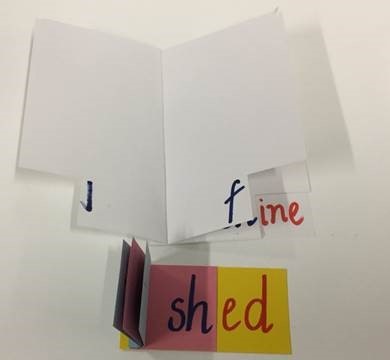
As a follow up, students make a flip rime book. Fold several A5 blank pages in half to class a pocket-size book. Staple. Get out the back page intact. Tape the rime on the bottom right corner of the back page. Cutting a small square out of the right bottom corner on each of the other pages so the recorded rime is visible.
Students then record an onset on each page as close to the rime every bit possible. They illustrate, alloy, read and learn to spell the rimes. Students keep flip book in their book box to be referred to during literacy activities.
Differentiation of this job
- students who crave a large amount of scaffolding can make an 'ed' flip rime book using the displayed onsets to help them with the spelling and writing of the new words
- provide some other one syllable words from the text (eg: vine, lunch, green) and ask students to identify the rime and then change the onset to make new words.
Foundation Level: Hearing and generating words that rhyme
Text
My Dog Rags, Author Kerrie Shanahan, Programme Flight Start to Literacy
Published past Eleanor Pall Publishing Pty Ltd.
© EC Licensing Pty Ltd.Reproduced by permission
Resources required
- Flashcards with selected rhyming words written on them (docx - 24.89kb)
- Big book My Canis familiaris Rags by Kerrie Shanahan
- YouTube admission
Links to the Victorian Curriculum - English language
- English, Speaking and Listening, Language: Phonics and discussion noesis
- Foundation: Identify rhyming words, ingemination patterns, syllables and some sounds (phonemes) in spoken words (Content description VCELA168)
- English, Reading and Viewing, Language: Phonics and give-and-take knowledge
- Foundation: Recognise all upper- and lower-instance letters and the most mutual audio that each alphabetic character represents (Content description VCELA146)
- English language, Reading and Viewing, Language: Expressing and developing ideas
- Foundation: Recognise that texts are made up of words and groups of words that brand meaning (Content description VCELA144).
Links to Victorian Curriculum - English as an Additional Language (EAL)
Pathway A
Speaking and listening
Level A1
- Imitate pronunciation, stress and intonation patterns (VCEALL027)
Reading and viewing
- Recognise some letters of the alphabet (VCEALL049)
- Identify some sounds in words (VCEALL050)
- Recognise some common messages and letter patterns in words (VCEALL051)
Level A2
Speaking and listening
- Identify and produce phonemes in blends or clusters at the beginning and stop of syllables (VCEALL110)
Reading and viewing
- Recognise all letters of the alphabet (VCEALL130)
- Chronicle most letters of the alphabet to sounds (VCEALL131)
- Use knowledge of letters and sounds to read a new word or locate key words (VCEALL132)
Learning intention
I am learning to hear and say words that rhyme by listening to the heart and terminal office of a discussion.
Success criteria
I tin can hear and say two words that rhyme.
I can think of some other discussion that rhymes with my pair.
- Mind to My Dog Rags clip on YouTube (e.g. 0.00-0.40 chorus only)
Model deportment for flip flop, wig wag and zig zag. Children join in on the 2d viewing. Aurally identify the words that rhyme e.chiliad. Rags/sags, wag/zag, wig/zig, he/me and what part of the word makes them rhyme.
- Use the shared reading practice to read big book My Domestic dog Rags past Kerrie Shanahan for enjoyment and understanding. Reread the text and ask students to listen out for rhyming words on selected pages e.g. 2,5,xvi. Reinforce what makes each set of words rhyme. Write rhyming words on whiteboard (e.k. Rags/sags, slops/stops, pet/met, see/me) and on prepared flashcards.
- Model game of tic tac toe with selected rhyming words to back up phonic identification.
- Students work with a partner. Each pair has a set up of cards with rhyming words from the story written on. Play a game of tic tac toe to identify the words.
- Pairs plow cards over. Play a game of concentration/memory where partners have to observe 2 words that rhyme to brand a pair. Teacher roves student pairs to support or differentiates by working with a small group.
- Ask pairs to cull one set of rhyming words from their memory game. Say the words and recollect of new words that rhyme with the pair.
- Return to principal group and a member from each group share a rhyming pair and a new rhyming word.
- Return to success criteria. Students turn to their partner and share the ii rhyming words they know. Additionally share a new rhyming word that matches the pair. Use the thumbs up/sideways/down to bespeak their success at the task.
Differentiation
In a higher place: Record unlike rhyming words from the text on flashcards that were non explicitly highlighted and inquire students to utilise in paired groups.
Give paired groups blank flashcards and inquire them to write their ain pairs of rhyming words.
Below: Students who require more assistance could piece of work in a minor teacher group.
Pronoun reference
Lesson Overview
This text provides opportunities for:
- investigating the use of pronoun references used every bit linking devices to brand a text cohesive. One manner an author sets upwards links in a text is to use pronouns to refer back to a substantive or noun group which has already been mentioned.
- building comprehension by supporting students to empathise that pronouns tin can take the place of nouns or substantive groups in a text. By linking the pronouns to the correct noun or noun group, readers are better able to understand the content including character development and the interplay between characters.
Text
Go to Sleep, Jessie!
Text copyright © Libby Gleeson 2014, Illustrations copyright © Freya Blackwood 2014
Published past Little Hare, an imprint of Hardie Grant Egmont
This flick story book is a narrative near 2 siblings. Jessie, the baby, moves into her big sis'southward chamber and her crying quickly unsettles her big sister. The story follows the big sister'south unsuccessful attempts to placate the infant and get her to sleep. After Dad intervenes and takes Jessie for a ride in the car, the big sister realises her bedroom is not the same without her baby sister. The story concludes with both siblings asleep in Jessie'south cot.
Links to the Victorian Curriculum - English
English, Writing, Language: Text construction and organisation
Level iv: Sympathize how texts are fabricated cohesive through the use of linking devices including pronoun reference and text connectives (Content description VCELA290).
English, Reading and Viewing, Literacy: Interpreting, analysing, evaluating
Level 4: Employ comprehension strategies to build literal and inferred meaning to expand content noesis, integrating and linking ideas and analysing and evaluating texts (Content description VCELY288).
Links to Victorian Curriculum - English as an Boosted Language (EAL)
Pathway B
Speaking and listening
Level BL
- Utilise words from sets related to firsthand chatty need, interest or feel (VCEALL180)
Level B1
- Use learnt words in speech (VCEALL260)
Level B2
- Utilise, in voice communication, vocabulary and structures learnt from spoken and written texts (VCEALL341)
Reading and viewing
Level BL
- Understand the sequence of events in a familiar text (VCEALL201)
- Use basic terminology of reading (VCEALL202)
- Brand simple predictions or inferences nearly a text, with support (VCEALC189)
Level B1
- Understand the sequence of key words, phrases or ideas in a familiar text (VCEALL281)
- Use some of the terminology of reading (VCEALL282)
- Make simple predictions or inferences nigh a text (VCEALC269)
Level B2
- Empathise the relationships between events or ideas in a text (VCEALL362)
- Understand and apply a range of learnt metalanguage to talk nigh text (VCEALL363)
- Make and substantiate inferences and predictions when reading or listening to a text read aloud (VCEALC350)
Level B3
- Understand the cohesion of ideas between and within paragraphs (VCEALL441)
- Understand and apply the appropriate metalanguage to talk most the structures and features of a text (VCEALL442)
- Discuss texts with some understanding of meaning beyond the literal level, moving towards the inferential level (VCEALC429)
Office of the reader
Text decoder/Text participant.
Group size
Small-scale group.
Learning intention
We are learning that when we read pronouns tin can take the identify of nouns or substantive groups in a text.
Success criteria
- I can locate the pronouns in a page of text I am reading.
- I can link the pronouns to a noun or noun group in the text.
Lesson sequence
- Introduce the learning intention. Explain to students that authors apply pronouns in their texts to take the place of nouns or noun groups. They do this to make their texts more cohesive. Readers need to be enlightened of what pronoun refers to what noun or noun groups so they can make meaning of the text.
- Revise what pronouns are and display in a prominent place where the pocket-size grouping can see view easily.
Personal pronouns
I, me (singular) us, nosotros (plural) [get-go person, 'speaking']
yous (singular and plural) [second person - 'spoken to']
he, she, him, her, it (singular) they them (plural) [third person - 'spoken 'of] - Read Go To Sleep Jessie! by Libby Gleeson and Freya Blackwood for enjoyment and understanding.
- Reread pages two and 3 once again with the students, making sure the small grouping can see the words in the text or enlarge a section for ease of viewing. As students join in the reading, ask them to look carefully for the personal pronouns and identify them.
e.g. Jessie is screaming.
Every night she does this. Ever since she moved into my room.
'Exist placidity,' I say. 'Get to sleep.'Then ask who the pronouns are referring to. For instance,
" Who is the pronoun 'she' referring to? She takes the place of the noun or noun grouping. What noun in the first sentence is she referring to? Students reread. She must be referring to Jessie. I can exam in the side by side sentence when I see she again. Does it make sense to say Jessie moved into my room? Does that fit with the pregnant in the story? Yep it does." Who is the pronoun 'I' referring to ('Exist placidity,' I say)? Inquire students to reread the last sentence on page 3. From the illustration on folio 3 I can see a large sis sitting on a bed. She must be telling the story. I wonder what her name is? It is her room that Jessie the baby has moved into. I know because she calls the room 'my room'.
Note to teachers: The word 'my' is not a pronoun. It is a possessive determiner (often called a possessive adjective). My comes earlier the noun 'room' to show who owns the room.
Students work in pairs. Refer to the success criteria. Give them a department of the text and inquire them to highlight the pronouns and brand the link to the relevant substantive or noun group. Suggested pages might exist:
Page 5
Jessie keeps screaming.
'If you cease screaming,' I say.
'I'll let y'all concord T-Carry.'
I climb out of my bed and pass him to her.Double page nineteen and 20
I stand at the window and scout the car drive down the street and turn the corner.
Then information technology does information technology again and over again. - Pairs share their work and their thinking. Ask students to supervene upon the pronouns with the relevant nouns or noun groups. How does this alter the text? Reiterate the apply of pronouns is i way to make a text appear more cohesive.
- Ask students to read independently. As they read use a gummy note to highlight a section that contains pronouns.
- After reading students endeavor to link the pronouns to the correct substantive or noun grouping. Record in their Reading Response Book.
- The instructor selects a representative to clear their learning to the main grouping at the determination of the reading lesson.
ABC Education Literacy Mini Lessons
The Department collaborated with ABC Education to create a series of videos. All sixteen mini lessons based on content from the Literacy Instruction Toolkit are available on the ABC Education literacy mini lessons page.
Level 1 syllable lesson
This lesson volition introduce the traditional rhyme 'Miss Mary Mack' via an enlarged text through the practice of shared reading.
The instructor will select some of the words from the text to introduce and teach syllables. Metalanguage such equally vowel, consonant and syllable will exist taught/reinforced.
Students will have the opportunity to investigate words and the number of syllables via clapping and clave sticks.
Text
Traditional Rhyme 'Miss Mary Mack'
Miss Mary Mack, Mack, Mack
All dressed in black, black, black
With argent buttons, buttons, buttons
All down her back, dorsum, back.
She asked her female parent, mother, mother
f or fifty cents, cents, cents
To see the elephants, elephants, elephants
Bound over the fence, fence, fence.
They jumped and so high, high, high
they reached the sky, sky, sky
And didn't come back, back, back
Till the quaternary of July, July, July.
Links to the Victorian Curriculum - English
Victorian Curriculum (English), Speaking and Listening, Language: Phonics and discussion knowledge
- Foundation: Identify rhyming words, alliteration patterns, syllables and some sounds (phonemes) in spoken words (Content clarification VCELA168).
- Level 1: Place the separate phonemes in consonant blends or clusters at the beginnings and ends of syllables (Content description VCELA203).
Victorian Curriculum (English language), Reading and Viewing, Language: Phonics and word knowledge
- Level one: Netherstand that a letter of the alphabet tin can represent more than ane sound, and that a syllable must comprise a vowel sound (Content description VCELA183).
Links to Victorian Curriculum - English as an Additional Language (EAL)
Pathway A
Speaking and listening
Level A1
- Imitate pronunciation, stress and intonation patterns
 (VCEALL027)
Level A2
- Echo or change a sentence or phrase, modelling rhythm, intonation and pronunciation on the spoken communication of others (VCEALL109)
Reading and viewing
Level A1
- Recognise some common letters and letter of the alphabet patterns in words (VCEALL051)
- Adopt the teacher's intonation patterns when reading familiar texts (VCEALL054)
Level A2
- Utilize knowledge of letters and sounds to read a new word or locate key words (VCEALL132)
- Read familiar texts with some fluency (VCEALL135)
Resources required
- Enlarged copy of the traditional rhyme Miss Mary Mack (docx - 23.85kb)
- Definition of syllables (docx - 23.18kb)
- Prepared flashcards with individually recorded words from the rhyme (e.g. button, fence, July, meet, elephants, over, heaven, back, female parent, 50, didn't, they)
- Instrument for clapping-easily, fingers, musical instruments (e.chiliad. clave sticks, drums, tambourines, triangles, maracas).
Learning intention
We are learning how to break words up into syllables.
Success criteria
- I tin say what a syllable is.
- I tin handclapping the number of syllables in a give-and-take.
- To help me work out the number of syllables I tin cross bank check by looking at a discussion to observe the vowel or vowel-like sounds within it.
Lesson sequence
- Introduce the traditional rhyme Miss Mary Mack through the didactics practice of shared reading. Ask students to join in on the repetitive sections of the text.
- Refer to the learning intention and define syllable (come across syllable awareness, definition of a syllable), vowel and consonant. Record the vowels where students can encounter them.
- Refer to the success criteria and explain.
- Use the prepared flashcards with individual words from the rhyme written on them (e.g. button, argue, July, see, elephants, over, sky, back, mother, 50, didn't, they). Recall aloud to model how to establish the number of syllables in some of the words.
Clap the shell
Cross check by listening for the vowel sounds
Identify the vowels or letters that make vowel-like sounds on the flashcards including (e.g. July, fifty), words that have silent letters (e.g. fence) or are contractions (eastward.yard. didn't) - Mitt out musical instruments to students. Select some examples and ask students to plough and work with a partner. Identify the number of syllables in a give-and-take past playing the beats with their instruments.
- Share student findings. Prompt students to explicate their thinking.
- Brand link to why knowing syllables is an important skill for writing and reading
If you can intermission a word into syllables, yous can hear the sounds and then match to letters to write it down (encode)
If y'all are reading and you come beyond a new/unknown word you can break into syllables to help decode it. - Revisit the enlarged version of Miss Mary Mack. Students reread a verse clapping the syllables (or playing their musical instrument).
- Return to the success criteria. Check students understanding of what a syllable is and their conviction with clapping the number of syllables in a discussion.
ABC Educational activity Literacy Mini Lessons
The Section collaborated with ABC Instruction to create a series of videos. All 16 mini lessons based on content from the Literacy Educational activity Toolkit are available on the ABC Education literacy mini lessons page.
Source: https://www.education.vic.gov.au/school/teachers/teachingresources/discipline/english/literacy/readingviewing/Pages/exampleshared.aspx
0 Response to "Weekly Structure for Shared Reading in Kindergarten"
Post a Comment